Built to Last, Stuck to Wear: What Happens When Your Alter Ego Refuses to Leave
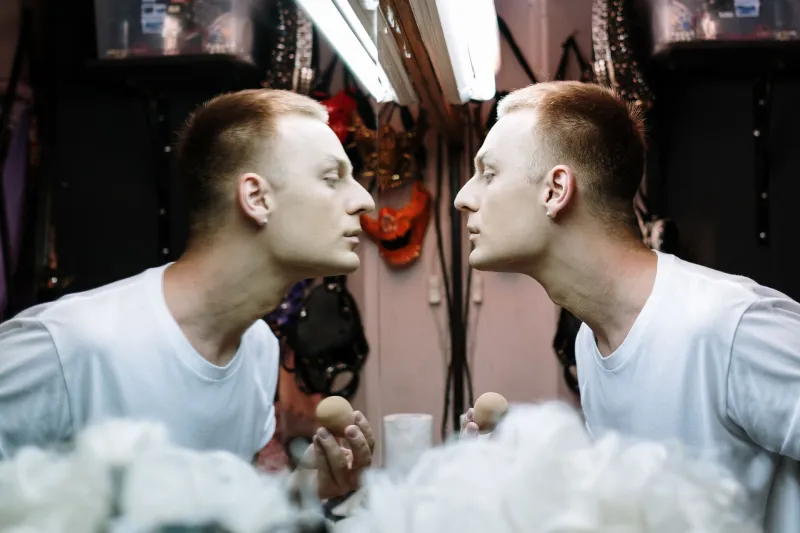
Every great artistic persona starts as a costume — something you slip on before the lights come up. But for some creators, the costume eventually slips on them. At what point does a deliberately crafted image stop being a tool and start being a cage?
There's a particular kind of creative trap that doesn't announce itself. It doesn't arrive with a warning label or a dramatic turning point you can point to later in interviews. It creeps in slowly, the way ivy grows over a brick wall — quietly, persistently, until one day you look up and realize the structure underneath has completely disappeared.
We're talking about the moment a performer's constructed persona calcifies from choice into expectation. When the character you built to get the crowd's attention becomes the only version of yourself the crowd will accept.
The Original Bargain
Let's be honest about why personas get built in the first place. The music industry, the film world, the broader entertainment machine — none of it rewards ambiguity in a newcomer. Audiences want a handle. Something to grab onto. So artists make a deal, sometimes consciously and sometimes not: I'll give you a version of me that's legible, and you'll give me a platform.
It's a reasonable trade at the start. Ziggy Stardust got David Bowie into arenas. Slim Shady gave Eminem a vehicle for chaos that felt separate enough from Marshall Mathers to be survivable. Beyoncé's Sasha Fierce was, by her own description, an alter ego she needed because she was too shy to perform as herself.
The persona serves a genuine psychological function. It's armor. It's permission. It's a way of saying this isn't really me taking this risk — it's the character. That distance can be enormously liberating, especially early in a career when the stakes feel existential and the self feels fragile.
But armor, worn long enough, starts to feel like skin.
When the Audience Owns the Character
Here's the part nobody talks about enough: the moment you release a persona into the world, it stops belonging entirely to you. The audience takes it home. They write it into their own stories. They tattoo it on their bodies, build playlists around it, use it as a shorthand for entire periods of their lives. The persona becomes load-bearing — not just for your career, but for other people's identities.
That's a beautiful thing, genuinely. That's what art is supposed to do. But it creates a deeply complicated dynamic when the artist on the inside has quietly moved on.
Brand strategist and creative consultant Denise Okafor, who has worked with musicians navigating public image pivots, describes it this way: "There's a grief cycle that happens for the audience when an artist evolves away from the version they fell in love with. And a lot of artists feel responsible for that grief. So they keep performing a version of themselves that they privately buried years ago."
That's the trap in its purest form. Not external pressure alone — but the artist's own empathy weaponized against their growth.
The Calcification Point
Psychologists who study identity formation sometimes use the term narrative foreclosure — the point at which a person stops imagining alternative futures for themselves because one story has become so dominant it crowds everything else out. For artists, narrative foreclosure can happen in public, in real time, with millions of witnesses.
Think about how quickly a cultural moment can harden into a brand. One era-defining album, one iconic film role, one viral aesthetic — and suddenly the world has decided what you are. Not what you were doing then, but what you are, permanently, full stop.
The pressure to stay consistent with that calcified image isn't always malicious. Sometimes it comes from well-meaning fans. Sometimes it comes from labels or studios protecting a proven commercial asset. Sometimes — and this is the most insidious version — it comes from the artist themselves, who has internalized the audience's expectations so thoroughly that they can no longer locate the line between performance and personhood.
"I've talked to artists who genuinely couldn't tell me what music they liked when no one was watching," Okafor says. "The persona had filled in all the space where a private self used to live."
The Chameleon's Dilemma
What makes this conversation so layered is that adaptability — the very thing the best artists are celebrated for — can actually accelerate the problem. An artist who is good at building personas might build one so convincing, so fully realized, that it becomes impenetrable from the outside and inescapable from the inside.
The chameleon metaphor cuts both ways here. The ability to shift, to take on color and form in response to your environment, is a survival skill. But a chameleon that has been sitting on the same branch for a decade isn't adapting anymore. It's just... stuck. Matching a background that may not even exist the way it used to.
The artists who navigate this best tend to share one quality: they treat their personas as collaborators rather than identities. They maintain an internal clarity about the difference between the character and the person performing it, even when that distinction is invisible to the outside world.
Singer-songwriter and performer Callie Marsh, who spent several years operating under a heavily stylized stage identity before gradually dissolving it into a more fluid public presence, puts it plainly: "The character was never a lie. It was a real part of me, amplified. The problem was when I started shrinking the rest of myself to fit the amplified part. That's when it stopped being creative and started being just... survival."
Finding the Exit
So how do you actually get out? How do you reclaim a self that's been publicly overwritten?
The answers vary, but a few patterns show up consistently. The first is gradualism — rather than a dramatic public rebrand that invites backlash and confusion, slowly introducing new dimensions, new sounds, new aesthetics that expand the frame without explicitly rejecting what came before. Think of it less as demolition and more as renovation.
The second is transparency, used carefully. Some artists have found that directly naming the evolution — talking openly about who they were performing and why, and who they're becoming — actually deepens audience trust rather than breaking it. It reframes the persona not as a deception but as a chapter.
The third, and maybe the most underrated, is simply making work that doesn't fit the box and releasing it anyway. Not explaining it. Not apologizing for it. Just putting it out there and letting the audience catch up or not. Some won't. But the ones who do tend to form a different, more durable kind of connection.
The persona was never the point. It was always just the door. The work — the real, shifting, uncontainable work — is what lives on the other side.
And the door? It was always yours to walk back through.