Less Is the Whole Point: Why the Blank Space in Art Is Screaming at You
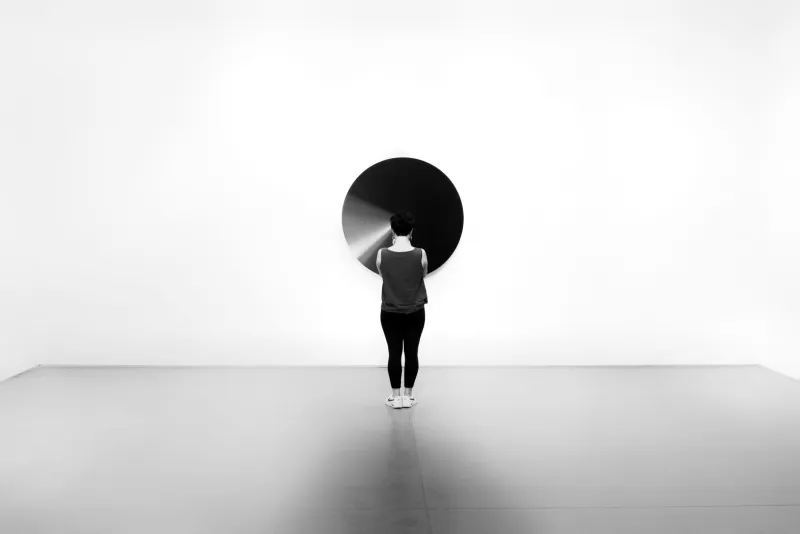
There's a painting hanging in a gallery in New York right now that stops people cold. Not because it's elaborate. Not because the brushwork is technically dazzling or the color palette is doing something wild. It stops people because roughly half of the canvas is bare. Untouched. Just the raw, off-white grain of the material sitting there like it's waiting for you to figure something out.
And most people do figure something out. They just can't explain what.
That experience—that wordless gut-punch from a void—is not an accident. It's a strategy. And it's everywhere right now.
The Art of Leaving Things Out
Negative space isn't a new concept. Designers have leaned on it for decades. Logo nerds still geek out over the hidden arrow in the FedEx wordmark or the bear tucked into the Toblerone mountain. But what's shifted in contemporary creative culture is the emotional weight artists are now placing on absence itself—not as a clever trick, but as the entire message.
Visual artists like Kara Walker have long used silhouette and shadow to let the empty space carry historical trauma in ways that explicit imagery sometimes can't. The black cutout figures against white backgrounds force your eye to reckon with what's not depicted—the interior lives, the voices, the full humanity of people history tried to erase. The absence does the talking.
In music, you hear it in the work of producers who've started stripping tracks down to almost nothing. Phoebe Bridgers built an entire sonic identity around the sound of a room breathing. Bon Iver's more experimental output leaves gaps in the mix that feel less like mistakes and more like questions you're supposed to sit with. Even in hip-hop, producers like Knxwledge have made careers out of records that feel half-finished on purpose—samples that cut off too soon, beats with deliberate holes punched through them.
The silence isn't filler. The silence is the feature.
Why Now, Though?
Here's where it gets interesting: the timing of this cultural obsession with restraint is not coincidental.
We are living through the loudest moment in human history. Every platform is optimized to grab attention. Every feed is a fire hose. Every algorithm rewards volume, frequency, and stimulation. Your phone buzzes. Your inbox overflows. A notification badge sits on forty-three different apps. The average American adult now encounters somewhere between 4,000 and 10,000 brand messages per day, and that's before you factor in the content you actually choose to consume.
Against that backdrop, restraint isn't just an aesthetic choice. It reads as an act of resistance. When an artist withholds, when a filmmaker holds a shot two beats past comfort, when a novelist leaves a chapter without resolution—it registers as radical honesty. Like they're saying: I trust you enough not to explain this.
That trust is rare. And people are starving for it.
Film Has Figured This Out (Mostly)
Some of the most talked-about cinematic moments of the last decade aren't explosions or revelations. They're pauses.
Think about the long, nearly wordless stretch in The Witch where the family just... falls apart in real time. Or the way Aftersun uses footage gaps and half-remembered images to say more about grief and memory than any monologue could. Director Charlotte Wells understood that the absence of explanation was the explanation. What we don't see—what the protagonist didn't see or couldn't process—is the film's emotional core.
Even mainstream TV has started catching on. Severance built an entire visual language around institutional blankness—those wide, empty corridors aren't set dressing, they're psychological pressure. The show's most suffocating moments have almost nothing happening in them.
The blank frame, the held silence, the unresolved chord—these aren't failures of nerve. They're the whole move.
Writers Are Playing the Same Game
In literary fiction, writers like Jenny Offill and Ocean Vuong have made fragmentary, elliptical structures their signature. Offill's novels read like someone handed you a journal with half the entries torn out—and somehow that makes the remaining pieces hit harder. Vuong writes around trauma as often as he writes through it, circling the wound rather than pressing directly on it.
What both writers understand is something psychologists have been saying for years: the human brain fills gaps. When you're given a complete, fully-explained narrative, you receive it passively. But when a story leaves space, your imagination activates. You co-create the meaning. And what you co-create is personal, specific, and therefore far more resonant than anything the author could have spelled out.
The reader becomes a participant. The viewer becomes an interpreter. The listener becomes a collaborator.
That's a different relationship entirely.
The Chameleon Principle
There's something almost shape-shifting about how negative space works across disciplines. In a painting, it's the unpainted canvas. In music, it's the rest between notes. In writing, it's the chapter that doesn't exist. In film, it's the cut that happens a moment too early. The form changes, but the underlying principle stays consistent: what you choose not to do defines you as much as what you do.
That's an uncomfortable idea for a lot of creators, especially in an era that rewards output. Post more. Release more. Be everywhere. The pressure to fill every inch of available space—creative, digital, emotional—is relentless.
But audiences are increasingly sophisticated readers of restraint. They can tell the difference between a gap that exists because someone ran out of ideas and a gap that exists because someone trusted them. The former feels lazy. The latter feels like a gift.
Learning to Sit in the Quiet
If you've ever stood in front of a painting and felt something you couldn't name, or listened to a song that broke you open without a single lyric, or read a book that ended mid-thought and felt more complete than any tidy conclusion—you already understand this.
You've already been moved by the color that isn't there.
The most honest creative work being made right now isn't trying to give you everything. It's trying to give you just enough. Just enough to find your own way in, to make the meaning your own, to feel something that belongs specifically to you.
In a world that won't stop talking, that kind of silence is the loudest thing in the room.