Two Voices, One Song: How Collaboration Quietly Rewrites Who You Are
There's a myth that the best creative work comes from a single, pure, uninterrupted vision. The lone genius locked in a studio at 2 a.m., channeling something untouchable and entirely their own. It's a romantic idea. It's also kind of a lie.
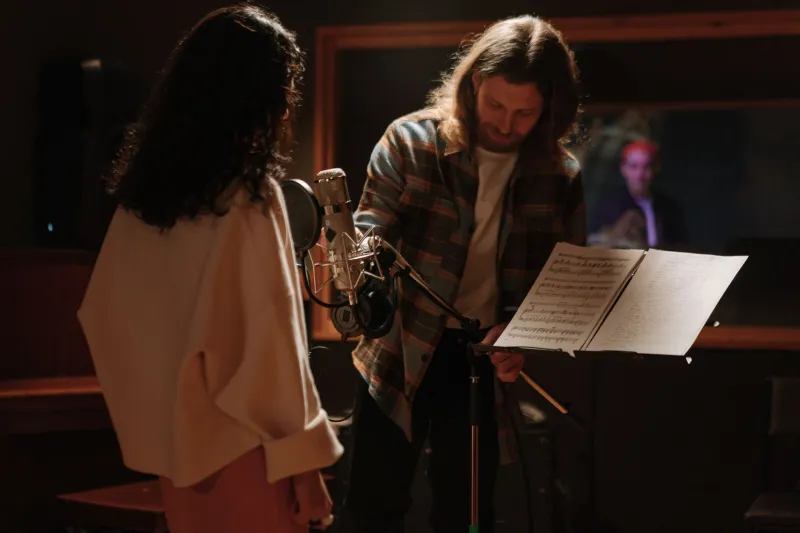
Some of the most transformative art — the stuff that genuinely shifts culture — came from two or more people colliding in a room and refusing to fully agree. And what nobody talks about enough is what that friction does to the people involved, not just the final product.
Collaboration doesn't just change the work. It changes you.
The Myth of the Untouched Vision
Every serious creative has a version of their artistic identity they're quietly protective of. A set of instincts, habits, and aesthetic preferences that feel like theirs — the signature moves they've spent years developing. Walk into a collaboration with that locked-in self-image, and the whole thing becomes a turf war waiting to happen.
Think about what went down when Kendrick Lamar and Taylor Swift both entered their most critically acclaimed eras. Neither of them got there alone. To Pimp a Butterfly was built in dialogue — with Flying Lotus, Thundercat, Pharrell, and a rotating cast of collaborators who each pulled the project somewhere Kendrick couldn't have gone solo. Swift's Folklore was born out of a remote creative partnership with Aaron Dessner that she never would have sought out under normal circumstances. A global pandemic forced the collaboration, and what came out of it sounded nothing like anything she'd made before.
In both cases, the artist didn't just use a collaborator. They were used by the collaboration. Shaped by it. Quietly rearranged.
When Your Instincts Become the Problem
Here's the uncomfortable part: the things that make you good on your own are often the exact things that make you difficult to work with.
A filmmaker who has an obsessive eye for visual symmetry might bulldoze a co-director who thinks emotionally rather than geometrically. A songwriter who writes every lyric from a place of raw personal experience might clash hard with a producer who thinks in abstraction and mood. These aren't failures of talent. They're failures of translation — moments where two genuinely skilled people are speaking completely different creative languages.
The artists who figure out how to navigate that gap don't do it by abandoning their instincts. They do it by learning to hold those instincts a little more loosely. They develop a second skill set that runs parallel to their craft: the ability to stay curious about someone else's logic even when it conflicts with their own.
That's not compromise in the weak sense of the word. That's a form of creative athleticism most people never bother to train.
The Version of You That Only Exists in the Room
Here's what's fascinating about real creative partnerships — the ones that actually produce something worth talking about. They tend to surface abilities and tendencies in each person that never would have emerged in solo work.
Jay-Z and Kanye's Watch the Throne wasn't just two established artists combining their existing styles. It created something genuinely weird and maximalist that neither of them had done before — or has quite done since. The project demanded a version of each artist that could only exist in response to the other. Kanye's grandiosity needed Jay's cool authority to not collapse under its own weight. Jay's restraint needed Kanye's chaos to stay from going stiff.
That dynamic — where each person's weaknesses are quietly shored up by the other's strengths — is the actual engine of great collaboration. But it only works if both people are willing to be changed by the process. If you go in determined to stay exactly who you were when you walked through the door, you're not collaborating. You're just sharing a room.
Negotiating Without Losing Yourself
So where's the line? Because there's a real danger on the other side of this, too. Collaboration can sand down the edges of an artist's identity until there's nothing distinctive left. You've heard records that sound like that — overproduced, over-negotiated, committee-built into something technically competent and completely forgettable.
The difference between growth and erasure in a collaboration usually comes down to what you're willing to move on. The artists who come out of partnerships stronger tend to be rigid about their values — the emotional truth they want the work to carry, the core reason they make anything at all — while staying genuinely flexible about method. The how can shift. The why shouldn't.
That's a harder distinction to hold than it sounds. In the heat of a creative disagreement, it's easy to conflate the two. To fight for a specific chord change or a particular line of dialogue as though it represents something fundamental about who you are, when really you're just attached to your first instinct. Learning to tell the difference — between a non-negotiable and a habit — might be the most important skill a collaborative artist can develop.
Growth That Doesn't Ask Permission
The most honest thing you can say about deep creative collaboration is that it doesn't really ask whether you're ready to grow. It just starts the process, and you either go with it or you spend the whole project fighting yourself.
The chameleon doesn't deliberate about whether to change. It responds to the environment it's in. That's not weakness — that's a sophisticated form of intelligence, a sensitivity to context that allows for survival and, sometimes, something more than survival. Something like brilliance.
The artists who keep producing work that matters across decades tend to be the ones who figured out early that their identity isn't something to be defended. It's something to be tested. Collaborations are one of the best testing environments there is — high stakes, high friction, high reward.
You walk in as one version of yourself. If you're doing it right, you walk out as someone slightly harder to define, and significantly more interesting.
And that person? They've got better work ahead of them than the one who walked in alone.